Case Studies [Video Conference] Major U.S. IT Company
페이지 정보

작성자 MOPIC
작성일2026.03.09
작성일2026.03.09
본문
Case Study · Telecom / Video conferencing
Global IT Company: Developing a Glasses-Free 3D Display for Next-Generation 3D Video Communication
3D video calls that feel close to meeting in person
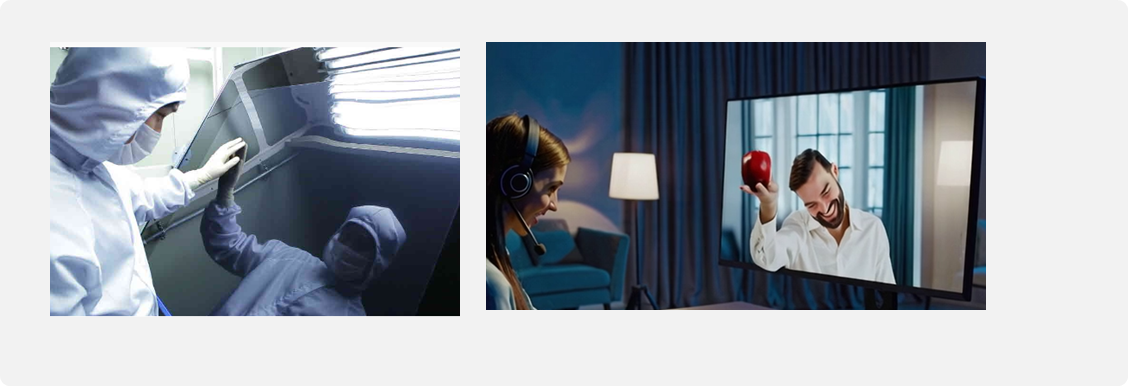
A major U.S. IT company evaluated several 3D display vendors and chose MOPIC as its technology partner. For a 3D video communication system that feels close to meeting in person, MOPIC handled optical structure design, engineering mock-ups and production process verification together with the customer.
At a glance
| Customer | Major U.S. IT company |
| Industry | IT / video communication / video conferencing systems |
| Application | Next-generation 3D video communication — a display that shows the other party as if in person |
| Development scope | Optical structure design to the customer's specification · engineering mock-ups · prototypes across lens and panel combinations |
| Verification | Viewing angle · stereoscopic resolution · depth expression / lens machining precision · panel assembly process · optical alignment quality |
| Collaboration | Technical documentation and evaluation reports matched to the customer's validation process |
| Project stage | Engineering mock-up co-development · performance and process verification |
| Key results | A 3D video communication experience close to face-to-face · 3D display performance validated through engineering mock-ups · a technical base for global product development |
1
Background and challenge
As video meetings become an everyday way to communicate, users expect a natural experience close to meeting in person, beyond a picture on a screen. Video communication on flat displays, however, struggles to convey space and presence. The customer therefore looked for a new 3D display technology partner for its next-generation 3D video communication system.
In video communication, "feels like being there" is not made by resolution alone. The other person's face has to sit in the screen at a real distance, and the angle you see has to change slightly as you move your head — the sense that there is a person in a space. A flat display cannot give that sense however sharp it is, and wearing glasses or a headset during a call is the opposite of the naturalness of meeting in person.
A company building such a product does not need a vendor of finished displays. It needs a technology partner that can design optics to a specification, build samples quickly for verification, and look at the production process together. That is why the customer compared vendors on optical performance, stereoscopic resolution and manufacturing capability.
2
How it was applied
After comparing several 3D display technology vendors, the customer selected MOPIC as its final technology partner on optical performance, stereoscopic resolution and manufacturing capability. MOPIC and the customer then co-developed a display engineering mock-up for the next-generation 3D video communication system. Rather than supplying a finished product, MOPIC's design, fabrication and verification became part of the customer's own product development process.
Existing assets — what the customer already had
The requirements specification for the next-generation 3D video communication system defined by the customer, its product validation process, and the camera, communication and software parts of the system. System design beyond the display module is led by the customer.
Added components — what MOPIC added
MOPIC carried out optical structure design and engineering sample fabrication to the customer's specification. Prototypes were built with a range of lens structures and panel combinations and their performance compared, evaluated mainly on:
· Viewing-angle verification
· Stereoscopic-resolution evaluation
· Depth-expression testing
Integration — how they were connected
MOPIC supported the manufacturing quality and process stability verification needed for global product development — lens machining precision evaluation, panel assembly process verification and optical alignment quality inspection — and provided technical documentation and evaluation reports matched to the customer's validation process, which the customer could use directly as decision material in its own development stages.
How it fits together
Specification · validation process Target performance and evaluation criteria for the 3D video communication system | → | Optical design + engineering mock-up Prototypes across lens and panel combinations · viewing-angle, resolution and depth verification | → | Process verification + evaluation reports Lens machining, panel assembly and optical alignment checks, with technical documentation | → | Customer product development Follow-on models built on the verification results |
Customer-owned Provided by MOPIC
Several lens structures and panel combinations were built and compared at the mock-up stage because a glasses-free 3D display's performance is decided by that combination. With the same panel, lens design shifts the balance between viewing angle and stereoscopic resolution, and an application like video communication, which must show the depth of a human face naturally, has a different balance point from general content. Only real samples let the customer fix the specification.
Process verification assumes mass production. How precisely lenses can be machined, and within what tolerance panel and lens align during assembly, decide product yield and stereoscopic quality. MOPIC delivered these items as reports in the format of the customer's validation process, so they could go straight into the customer's internal approval steps.
3
Results and value
| Item | Before | After (glasses-free 3D) |
|---|---|---|
| Video communication experience | Flat screen — little space or presence | 3D calls close to face-to-face |
| Development approach | Dependent on choosing an off-the-shelf display | Spec-based optical design + engineering mock-ups co-developed |
| Verification material | — | Viewing angle, stereoscopic resolution, depth + process verification delivered as evaluation reports |
| Development schedule | — | Fast sample production shortens verification · base for follow-on models |
A realistic 3D video communication experience
With a 3D display built on MOPIC's technology, the customer achieved a video communication experience closer to meeting in person than a flat screen allows.
Faster product development
MOPIC's fast sample production and technical responsiveness shortened the display development and verification process, and secured a technical base the customer can use to extend to additional models.
Customer interview
“
What matters most in next-generation video communication technology is giving users an experience close to meeting face to face. MOPIC's 3D display technology let us confirm new communication possibilities that convey space and presence.
— from the customer interview
Consider this approach if…
This way of working is not limited to video communication. Any manufacturer that wants to build a glasses-free 3D display into its own product can develop it with MOPIC the same way.
Where it applies
· Your product needs a 3D display with its own specification that off-the-shelf parts cannot meet
· You need to compare performance on real samples before fixing the specification
· Mass production is in view, so lens machining and assembly process stability must be verified too
· Global product development that needs verification reports and technical documentation for internal approval
Terms used in this article
· Engineering mock-up — a prototype built with real parts and structure to verify a design before mass production
· Stereoscopic resolution — the resolution delivered to each eye; in glasses-free 3D the two eyes share the panel's resolution, so lens design governs this value
· Viewing angle — the range of viewing angles within which the stereoscopic image is seen correctly
· Optical alignment — the assembly step that matches lens and panel positions precisely; alignment error determines stereoscopic quality and yield
Related case studies
[Telecom / Mobile Service] LG U+ and Global Telecom Operators →
Same telecom field — a smartphone 3D service built with HoloGlass and the SDK
[Medical / Image Analysis] EchoPixel →
Custom 65" and 32" displays developed for the customer's environment
Related products
Learn more
Glasses-free 3D: essential background →
Lenses, viewing distance, viewpoint tracking — the basics of glasses-free 3D
Glasses-free 3D glossary →
Optical design · cameras · 3D content formats · software acronyms
Contact
If you are considering a glasses-free 3D display module for your own product, tell us the intended use, the requirements (size, viewing distance, viewing angle, resolution) and your development schedule. We will help you work out the scope of collaboration, from optical design to engineering samples and process verification.