Case Studies [Industrial / Microscope] Solectrix
페이지 정보

작성자 MOPIC
작성일2026.03.09
작성일2026.03.09
본문
Case Study · Industrial / Microscopy
Solectrix: A Glasses-Free 3D Display for Digital Microscope Observation
Stereoscopic microscopy on a monitor, not through an eyepiece
Solectrix built a digital microscopy environment in which fine structures are observed in 3D on a monitor instead of through an eyepiece. A 15.6-inch custom glasses-free 3D display and the Native 3D SDK show stereo microscope video in real-time 3D while the existing viewer software stays as it is.
At a glance
| Customer | Solectrix (Germany) |
| Industry | Industrial analysis / digital microscopy / precision image analysis |
| Viewing environment | Laboratory bench — an analyst observing at close range for long periods |
| Display | 15.6" custom glasses-free 3D display (optics for the microscope observation distance, Adobe RGB 100%) |
| Key technology | Real-time glasses-free 3D display of stereo microscope camera video · high-resolution 3D output |
| Integration | Native 3D SDK — existing viewer software and 3D image processing workflow preserved |
| Project stage | Digital microscope viewer system — product development and commercialization |
| Key results | Stereo microscope video shown in glasses-free 3D in real time · less fatigue in long sessions with monitor-based observation · better efficiency and accuracy in the analysis environment |
1
Background and challenge
Conventional stereo microscopes require the eyes to stay fixed to the eyepiece, which causes considerable fatigue in long sessions. Demand for monitor-based digital microscope systems is therefore growing in research and industrial analysis. Most existing 3D displays, however, need 3D glasses and are unsuited to long working sessions.
A digital microscope replaces the eyepiece with a camera and shows the image on a monitor. Posture becomes free and images are easy to save and share, but one thing is lost: the stereoscopic view a binocular microscope gave each eye separately. On a flat monitor, surface relief, steps between components and the depth of tiny defects are hard to read by eye, so for precision work people end up going back to the eyepiece.
A display for digital microscopy therefore needs two things at once: comfortable to watch for hours without glasses, and fine structures shown precisely, without distortion. The second requirement includes resolution and color reproduction, which rules out using an ordinary display as it is.
2
How it was applied
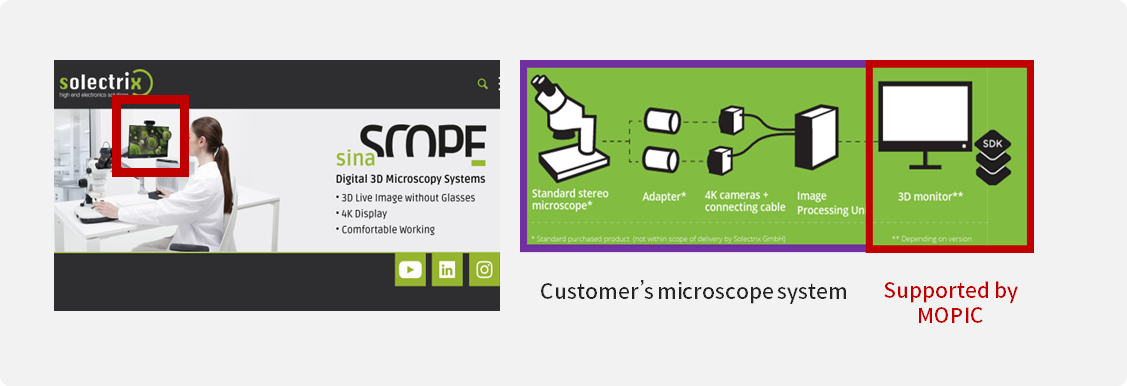
Solectrix applied MOPIC's glasses-free 3D display and 3D SDK to its digital microscope viewer system, building a digital microscopy environment in which video from the stereo microscope cameras is shown on the monitor in real-time glasses-free 3D.
Existing assets — what the customer already had
Solectrix's stereo microscope camera system, its own viewer software and its existing 3D image processing workflow. Neither the cameras nor the software structure changes.
Added components — what MOPIC added
MOPIC developed a 15.6-inch custom glasses-free 3D display for the laboratory environment and the microscope observation distance, with optics designed for close-range viewing of fine structures and a panel with high-resolution output and precise color reproduction.
· 3D optical design based on the microscope observation distance
· High-resolution 3D output suited to analyzing fine structures
· A panel with 100% Adobe RGB color gamut for precise color reproduction
Integration — how they were connected
MOPIC's Native 3D SDK made it possible to add 3D without changing the customer's existing software structure, and the integration was designed to fit naturally into the customer's existing 3D image processing workflow. The two camera images pass through the SDK and come out as the display's left and right viewpoints, so the viewer software simply receives and processes video as it always has.
How it fits together
Stereo microscope cameras + viewer software Left/right camera video and the existing image processing workflow | → | Native 3D SDK Left/right video converted to 3D output with no change to the software structure | → | 15.6" glasses-free 3D display Optics for the observation distance · high resolution · Adobe RGB 100% | → | Analyst Stereoscopic observation on a monitor, no eyepiece, no glasses |
Customer-owned Provided by MOPIC
The 15.6-inch size and the observation-distance optics go together. Microscope work means watching a monitor within arm's reach, a completely different lens design from a large conference-room display. The optics were designed for this distance so that the left and right images stay separate and fine structures remain crisp even up close.
The 100% Adobe RGB gamut reflects the nature of microscope analysis. In many tasks — oxidation of materials, plating condition, the result of tissue staining — color itself is the evidence, so adding depth while distorting color would undermine the tool's value. Securing both 3D and color accuracy is the point of this display.
Watch the video
3
Results and value
| Item | Before | After (glasses-free 3D) |
|---|---|---|
| Observation | Eyes fixed to the eyepiece, or a flat monitor with no depth | Real-time stereoscopic observation on a monitor, no glasses |
| Long sessions | Fatigue builds up in a fixed eyepiece posture | Free posture, less fatigue |
| Reading fine structures | Relief and steps hard to judge in a flat image | Structure and color read together — high-resolution 3D + Adobe RGB 100% |
| Software changes | — | Native 3D SDK keeps the viewer software and workflow |
A better digital microscopy environment
With the glasses-free 3D display, users observe fine structures more accurately and in true depth.
More comfort in long working sessions
Monitor-based 3D observation in place of the eyepiece has reduced user fatigue over long sessions.
Faster product development and commercialization
MOPIC's rapid prototyping and technical support let the digital microscope product be developed and brought to market faster.
Customer interview
“
In a digital microscope system, how accurately fine structures can be observed in three dimensions is critically important. MOPIC's glasses-free 3D display let us create a new way of observing, in which users perform precision analysis in a far more comfortable environment.
— from the Solectrix interview
Consider this approach if…
Not limited to microscopes. Any equipment where a person watches stereo camera video and makes judgments can get a stereoscopic observation environment the same way.
Where it applies
· You build or operate equipment that outputs video from two viewpoints — stereo microscopes, stereo cameras, endoscopes
· Inspection, analysis or surgical environments where operators watch a screen at close range for long periods
· Work where depth itself is the evidence — surface relief, steps, defect depth
· Equipment makers with their own viewer or analysis software who need to add 3D output without changing its structure
Terms used in this article
· Native 3D SDK — MOPIC's developer kit that adds 3D display capability without changing the existing software structure
· Stereo camera — a camera configuration that captures two viewpoints at once, like our two eyes, carrying stereoscopic information
· Adobe RGB 100% — a measure of the range of colors a display can reproduce; the display covers the full wide gamut used in print and analysis
· Observation-distance optical design — designing the lens for the distance at which it is viewed; the closer the viewing, the more a dedicated design is needed
Related case studies
[Medical / Image Analysis] EchoPixel →
The same pattern in medicine — 3D added with the Native 3D SDK while keeping the existing analysis platform
[Automotive / HMI] Renault →
Camera video shown in real-time glasses-free 3D — the same structure in a vehicle
Related products
Learn more
Glasses-free 3D: essential background →
Lenses, viewing distance, viewpoint tracking — the basics of glasses-free 3D
Glasses-free 3D glossary →
Optical design · cameras · 3D content formats · software acronyms
Contact
If you are considering a glasses-free 3D display for a microscope, inspection system or stereo camera system, tell us the camera configuration, the observation distance and your current viewer software environment. We will help you work out the right display size and specification and the scope of Native 3D SDK integration.