Case Studies [Medical / Image Analysis] EchoPixel
페이지 정보

작성자 MOPIC
작성일2026.03.09
작성일2026.03.09
본문
Case Study · Medical / Imaging
EchoPixel: A Glasses-Free 3D Display for Medical Image Analysis
CT and MRI in 3D, without glasses
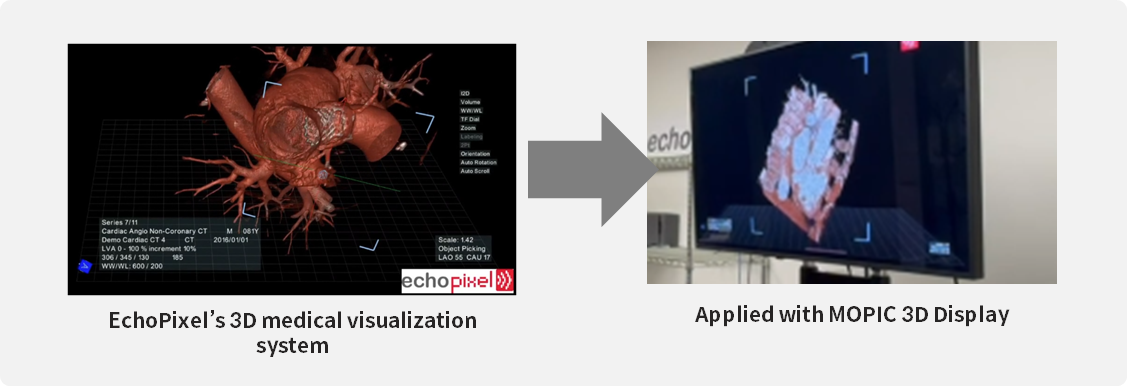
EchoPixel built a medical image analysis environment in which CT, MRI and ultrasound data is viewed in 3D straight from the monitor, with no headset or 3D glasses. The existing analysis platform stayed as it was; the Native 3D SDK and custom 65-inch and 32-inch displays added stereoscopic visualization.
At a glance
| Customer | EchoPixel (USA) |
| Industry | Medical image analysis / medical software / medical visualization |
| Viewing environment | Diagnosis and analysis rooms — clinicians at a monitor, individually or together |
| Display | 65" and 32" custom glasses-free 3D displays (optics designed for clinical viewing distances) |
| Key technology | 3D visualization reflecting the depth in the original image data · real-time 3D rotation and zoom |
| Integration | Native 3D SDK — 3D added without changing the existing medical imaging software structure |
| Project stage | Integrated into the medical image analysis platform and in operation |
| Key results | CT, MRI and ultrasound data visualized in glasses-free 3D in real time · more intuitive analysis and better diagnostic efficiency |
1
Background and challenge
Medical image data such as CT, MRI and ultrasound is mostly viewed on flat (2D) displays, which makes the depth and spatial relationships of complex anatomy hard to grasp intuitively. Interest in glasses-free 3D medical visualization that needs no extra equipment is therefore growing in clinical settings.
Medical image data is three-dimensional to begin with. CT and MRI are volumes built from hundreds of slices, and analysis software already renders those volumes in 3D. The problem is the last step: a flat monitor erases the depth. Clinicians rotate the view or page through slices to rebuild depth in their heads, and the more vessels overlap or structures get complex, the longer that takes.
A VR headset or 3D glasses can bring the depth back, but they are hard to use in a clinical setting: you need to look at the screen with colleagues as you analyze, and long sessions wearing them are tiring. What EchoPixel needed was 3D you simply look at, like the monitor you already use.
2
How it was applied
EchoPixel integrated MOPIC's glasses-free 3D display and 3D SDK into its medical image analysis platform, creating an environment in which CT, MRI and ultrasound data is visualized in 3D straight from the monitor, with no headset or 3D glasses. The platform stays as it is; only the output stage changes.
Existing assets — what the customer already had
EchoPixel's medical image analysis platform in operation, the CT, MRI and ultrasound data in it, and its existing 3D rendering workflow. Neither the software structure nor the data processing changes.
Added components — what MOPIC added
MOPIC developed 65-inch and 32-inch custom glasses-free 3D displays for the viewing distances and conditions of a clinical environment — the large screen for collaboration and conference use, the 32-inch for individual analysis — with optics designed for each distance.
· 3D optical design based on the viewing distance of a medical analysis environment
· 3D visualization reflecting the depth information in the original medical image data
Integration — how they were connected
MOPIC's Native 3D SDK made it possible to add 3D without changing the existing medical imaging software structure. The SDK takes the 3D rendering the platform already produces and outputs it as left- and right-eye images, so real-time 3D rotation and zoom, intuitive stereoscopic visualization of medical data, and natural depth that reduces fatigue in long sessions all work with the existing controls.
How it fits together
Medical imaging platform CT · MRI · ultrasound data and existing 3D rendering | → | Native 3D SDK Left/right viewpoint images with no change to the platform structure | → | 65"·32" glasses-free 3D displays Optics designed for clinical viewing distances | → | Clinicians Stereoscopic analysis and collaboration at the monitor, no glasses |
Customer-owned Provided by MOPIC
Here is what "no change to the structure" means with the Native 3D SDK. The analysis platform draws its 3D scene as usual; the SDK renders that scene once more from the two eyes' viewpoints and sends it to the display in the form it needs. To the platform it is like one extra output module, so existing functions and certified processing paths are untouched — an important difference in medical software, where the scope of a change is the scope of re-validation.
Two sizes were chosen because of the environment. The 65-inch is designed for collaboration and teaching, where several people watch from two to three meters; the 32-inch for one person analyzing at desk distance. The same content needs different lens designs when the viewing distance differs.
Watch the video
3
Results and value
| Item | Before | After (glasses-free 3D) |
|---|---|---|
| Reading depth and spatial relations | Rebuilt mentally by paging through slices and rotating | Anatomy and spatial relations perceived directly from the 3D image |
| Viewing equipment | Flat monitor, or headset / 3D glasses | 3D seen just by looking at the monitor |
| Collaborative analysis | Headsets are single-user — hard to review together | Several clinicians view the same screen together |
| Software changes | — | Native 3D SDK keeps the existing platform structure |
More accurate medical image analysis
With stereoscopic visualization, clinicians understand anatomical structures and spatial relationships more clearly.
Better collaboration among clinicians
Because 3D images can be seen simply by looking at the monitor, with no special equipment, collaborative analysis among clinicians has improved.
Wider medical applications
The system provides a foundation that extends beyond diagnosis and surgical planning to medical education, remote consultation and medical training.
Customer interview
“
In medical image analysis, how accurately anatomical structures can be understood is critically important. With MOPIC's glasses-free 3D display we built a new analysis environment in which clinicians grasp structures far more intuitively.
— from the EchoPixel interview
Consider this approach if…
The pattern is not limited to medical imaging. If you already have software that renders in 3D and you view the result on a flat monitor, it can be made stereoscopic the same way.
Where it applies
· You already run software that renders volume data in 3D — CT, MRI, ultrasound, 3D scans
· Results have to be reviewed and discussed by several people, so a headset does not fit
· Regulatory or validation burden means the existing software structure must be preserved as far as possible
· You operate environments with different viewing distances — individual analysis alongside collaboration or teaching
Terms used in this article
· Native 3D SDK — MOPIC's developer kit that adds 3D display capability without changing the existing software structure; outputs the platform's 3D scene from left and right viewpoints
· Viewing-distance-based optical design — designing the lens for the distance at which it is viewed; the same content needs a different design for desk distance and for a conference room
· Glasses-free 3D display — a display whose lens layer sends different images to the left and right eye, showing depth without glasses
· Depth information — how far in front of or behind the screen each part of an image sits; present in volume data but lost in flat output
Related case studies
[Medical / Education] Seoul National University Hospital Smart Simulation Center →
Same medical field — 3D endoscope video shared in glasses-free 3D in the training room
[Industrial / Microscope] Solectrix →
The same pattern — 3D added with the Native 3D SDK while keeping the existing analysis software
Related products
Learn more
Glasses-free 3D: essential background →
Lenses, viewing distance, viewpoint tracking — the basics of glasses-free 3D
Glasses-free 3D glossary →
Optical design · cameras · 3D content formats · software acronyms
Contact
If you are considering adding glasses-free 3D output to medical imaging or visualization software, tell us about your platform's rendering environment and viewing setup (individual analysis or collaboration, viewing distance). We will help you work out the scope of Native 3D SDK integration and the right display configuration.