Case Studies [Industrial / Remote Operation] Kalmar
페이지 정보

작성자 MOPIC
작성일2026.10.22
작성일2026.10.22
본문
Case Study · Industrial / Remote operation
Kalmar: Chooyu 32″ PoC for Remote-Operated Cranes
A remote-operation view with depth restored
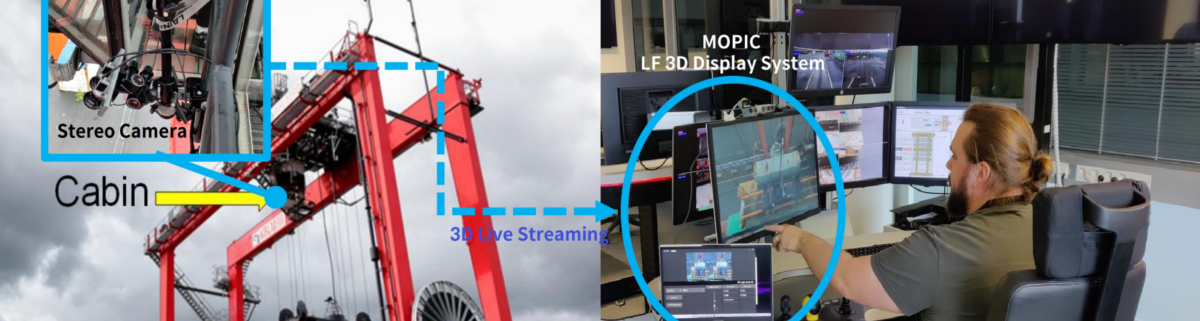
Finnish port-equipment company Kalmar, together with telecom operator Elisa and MOPIC, completed a PoC in which stereo camera video from a crane cabin is sent over 5G and viewed in 3D, without glasses, at a remote operation console. The console stayed as it was; only one monitor was swapped for a Chooyu 32″ glasses-free 3D display. Follow-up testing with crane operators is now under way.
At a glance
| Customer | Kalmar (Finland, port and logistics equipment) |
| Partners | Elisa (Finnish telecom operator, 5G network) · MOPIC |
| Industry | Ports and logistics / remote crane operation |
| Environment | Remote operation station — one operator watching from a fixed seat at the console |
| Display | Chooyu 32″ glasses-free 3D display — replaces one console monitor 4K UHD · Eye-tracking-based viewpoint alignment |
| Software | MOPIC Mirror (now MOPIC Hub) — converts stereo video to glasses-free 3D in real time on the console PC |
| Integration | Crane-cabin stereo camera → 5G → cloud WebRTC → MOPIC Mirror (now MOPIC Hub) → Chooyu 32″, live |
| Project stage | PoC completed · follow-up user testing under way |
| Key results | Live 3D video delivered over 5G and the cloud, confirmed at the remote console · existing console kept, only one monitor replaced |
1
Background and challenge
Ports are increasingly operating container cranes from remote operation stations instead of from the cabin. It moves operators out of high cabins and hazardous areas into an office, and lets one person take turns handling several machines. But all a remote operator sees is the video from cameras mounted on the crane.
The problem is that this video is flat. When picking up or setting down a container, the operator has to judge the distance between the spreader and the container, the stack height, and the clearance to nearby obstacles, and on a flat image that sense of distance disappears. The depth a cabin operator perceives naturally with two eyes has to be replaced with multiple screens and indirect cues.
3D can bring back that sense of distance, but the conditions are demanding. Operators work shifts and watch screens for hours, so 3D glasses or headsets are not a realistic option, and if the image lags behind reality it becomes dangerous, so latency is a precondition too. With the crane and the operation station far apart, the video has to travel over a network and still arrive in real time.
2
How it was applied
Kalmar, Elisa and MOPIC split the PoC into clear roles. Kalmar provided the crane, the stereo camera and the remote operation console; Elisa provided the 5G network; MOPIC provided the Chooyu 32″ display and the playback software. The crane and its control logic stayed unchanged; MOPIC's components came in at the last step, where the video reaches the operator — the display.
Kalmar · Elisa side — crane, stereo camera, console, 5G network
Kalmar's container crane and a remote operation console made up of several monitors. A stereo camera installed by Kalmar on the crane cabin captures two viewpoints, left and right, like a pair of human eyes, and the video goes up to the cloud over Elisa's 5G network.
Added components — what MOPIC added
MOPIC replaced one of the console monitors with a Chooyu 32″ glasses-free 3D display and added its playback software, MOPIC Mirror (now MOPIC Hub). The Chooyu 32″ uses Eye-tracking to follow the operator's eye position and align the viewpoint, so the 3D image holds even when the operator shifts position at the console.
· One console monitor replaced with a Chooyu 32″ — the other monitors unchanged
· 4K UHD · Eye-tracking aligns the viewpoint to the operator's eyes
· MOPIC Mirror (now MOPIC Hub) shows the streamed stereo video in glasses-free 3D in real time
Integration — how they were connected
5G and cloud WebRTC connect the crane and the console. The stereo camera video from the cabin goes up to the cloud over 5G and is streamed live to the remote console over WebRTC, where MOPIC Mirror (now MOPIC Hub) on the console PC receives it and shows it in 3D on the Chooyu 32″. No SDK development is involved: the streamed video is simply connected to the playback software. In remote operation, video latency is a safety issue, so the follow-up testing sets latency of 150 ms or less as the safety threshold.
How it fits together
Crane-cabin stereo camera Installed by Kalmar · captures left and right viewpoints | → | 5G · cloud WebRTC Sent over Elisa's 5G network · live WebRTC streaming | → | MOPIC Mirror (now MOPIC Hub) Real-time glasses-free 3D conversion on the console PC | → | Chooyu 32″ Replaces one console monitor · Eye-tracking | → | Remote operator Operates the crane with video that shows distance, no glasses |
Kalmar · Elisa side Provided by MOPIC
A remote operation station suits glasses-free 3D well. The operator's seat and the distance to the screen are fixed, and since one person watches the screen, Eye-tracking can follow their viewpoint to raise 3D quality. It is the same condition as Renault's rear-view system; the difference is that the video arrives over 5G and the cloud rather than through a cable inside the vehicle.
After the PoC, follow-up testing with real operating staff is under way. The solution is first tested in a virtual environment with an interim evaluation, then on real cranes at the Kalmar Automation test yard in Tampere, Finland. Technicians, crane operators and crane trainers use it directly, with the goal of confirming higher user acceptance and less eye fatigue than other solutions. The evaluation criteria are initial setup complexity, general user experience, eye fatigue, latency and safety (150 ms or less), added value, and accuracy / failure rate.
3
Results and value
| Item | Before | After (glasses-free 3D) |
|---|---|---|
| Distance judgment | Flat video — estimated from multiple screens and indirect cues | Distance between spreader and container perceived directly in 3D |
| Operator gear | — | No glasses or headsets — suited to long shift work |
| Console changes | — | Only one monitor replaced with a Chooyu 32″; the rest of the console unchanged |
| Video transport | — | Live 3D streaming over 5G and cloud WebRTC to a console far from the crane |
| Scalability | — | The same structure applies to remote operation of other port equipment and mining or construction machinery |
Live 3D remote-operation view over 5G, verified
The PoC confirmed that stereo camera video from the crane cabin can travel over 5G and the cloud and appear live on the Chooyu 32″ at the remote console. Operators could see the crane's working area in 3D from their seat, without glasses.
Console unchanged, one monitor replaced
The setup was complete once one monitor was replaced with a Chooyu 32″ and the playback software was installed, with no changes to the crane or the console structure. That keeps the cost of adding 3D to a remote operation system already in service low.
On to real-world validation
Through virtual-environment testing and on-site testing at the test yard, the user experience, eye fatigue and latency threshold are being validated with real operating staff. The same setup can move beyond port cranes to other remote operation systems where equipment is controlled from camera video.
Consider this approach if…
It is not limited to port cranes. Any remote operation where someone moves equipment while watching camera video can use the same structure.
Where it applies
· Ports, mines and construction sites that operate large machinery remotely — cranes, straddle carriers, excavators
· Systems where the equipment and the operation station are apart and video has to be sent over 5G or a network
· Operation stations where the operator watches a screen from a fixed seat for long periods — a good fit for Eye-tracking
· Cases with an existing operation console where 3D should be added by swapping a monitor
Terms used in this article
· Teleoperation — operating equipment from outside the cabin while watching video from cameras mounted on it
· Stereo camera — a camera setup that captures two viewpoints at once, like a pair of human eyes, to record depth
· WebRTC — a standard for exchanging video in real time between browsers and apps; used here to stream from the cloud to the remote console
· Eye-tracking — tracking the viewer's eye position with a camera and aligning the 3D image to it; suited to single-viewer setups with a fixed viewing position
· Chooyu 32″ — the 32-inch model in MOPIC's glasses-free 3D display lineup; 4K UHD, Eye-tracking, VESA mount, for a single viewer
· MOPIC Hub (formerly MOPIC Mirror) — MOPIC's playback software installed on a PC; converts stereo (SBS) or 2D video into glasses-free 3D for the display in real time, with no SDK development
· Spreader — the device a crane locks onto the top of a container to lift it
Related case studies
[Maritime / Remote Monitoring] KT · Hyundai Heavy Industries →
The same structure applied earlier — an autonomous boat's forward video sent over 5G and monitored in 3D at a remote control center
[Automotive / HMI] Renault →
Same pattern — camera video shown live in glasses-free 3D at a fixed viewing position
[Video Conference] Major U.S. IT Company →
Live video sent over a network and shown in glasses-free 3D
Related products
Learn more
Glasses-free 3D: essential background →
Lenses, viewing distance, viewpoint tracking — the basics of glasses-free 3D
Glasses-free 3D glossary →
Optical design · cameras · 3D content formats · software acronyms
Contact
If you are considering glasses-free 3D for a remote operation station or a camera-based equipment control system, tell us about the camera setup, how the video is transmitted, the operation console and the viewing distance. We will help you work out the right display configuration, integration method and latency requirements.